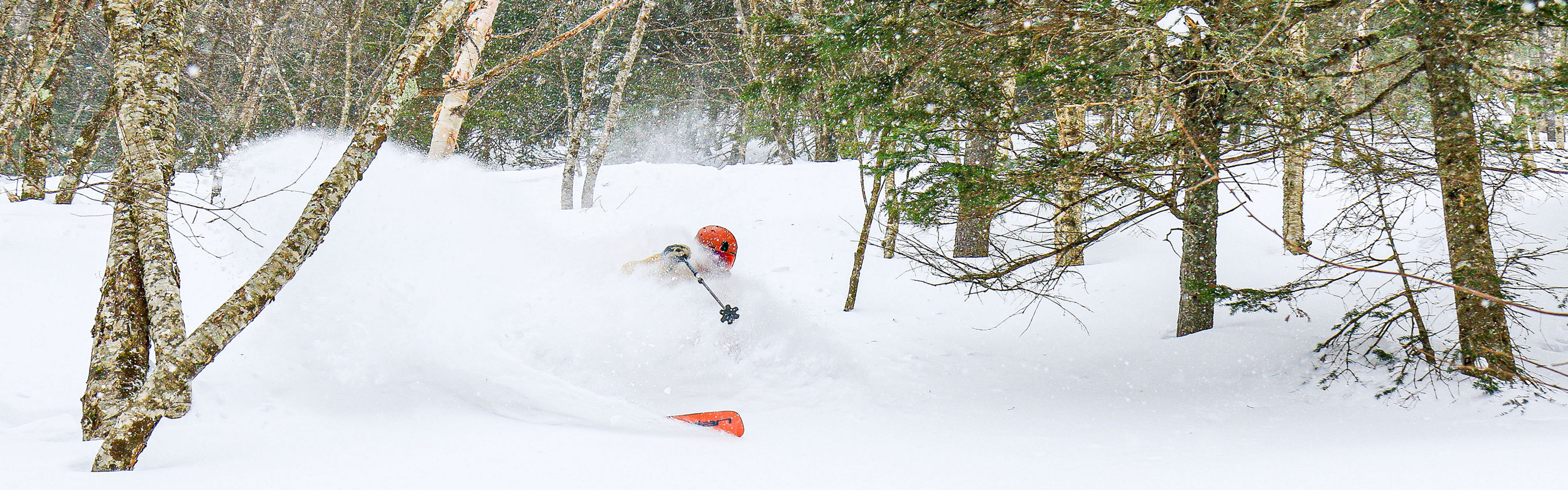

In short, it’s everything you need to know for that day of skiing summed up in a quick recorded message that is the most reliable daily forecast for anyone riding or skiing Vermont’s Mount Mansfield.
And it is something you should listen to every day — even when you are back home — because often Mount Mansfield will get very different conditions than the surrounding area, conditions even seasoned forecasters sometimes miss.
“It can be raining — or even sunny — in the village of Stowe and dumping snow up at the mountain,” says Scott Braaten, who has been skiing Stowe since 2008, describing himself as “a self-taught weather guru.” He now works for Stowe Mountain Resort and is often the voice on the recorded morning forecast on Stowe’s snow phone. To get that forecast, he combines his local knowledge with all the data the National Weather Service (NWS) provides out of its Burlington station.
As Braaten says: “The National Weather Service is 100 percent the place to go for the most reliable forecasts. Many of the NWS forecasters are skiers, and they are sitting in the Burlington Airport and can see Mount Mansfield,” says Braaten. “They know what’s going on and it’s where I get my data.” It’s a far better choice than relying on forecasters who may be 100 miles away and may not be aware of the variations in weather at Vermont’s ski mountains.
Measuring Weather Data on Mount Mansfield
What makes Mount Mansfield forecasts different from recreational forecasts in other parts of the state or from conditions reports submitted by ski areas? Mount Mansfield has weather stations near its summit that monitor hourly or daily data such as wind speed, temperature, precipitation and snowfall. That detailed information is relayed to the NWS, which posts it on its website.“There’s also this really cool feature on the NWS site that allows you to click at any point on a map and see what the weather is at various elevations,” says Braaten. “If you just Google ‘weather in Stowe,’ you’re going to get the weather in the village. The weather on the mountain can be very different.”
“A lot of people don’t know about that clickable map,” says NWS forecaster Matthew Clay, who is based in Burlington. “Because Mount Mansfield is so big, it has an impact on the weather,” says Clay. “It really pays to look around and click on different areas,” he says.
The highest mountain in Vermont, Mount Mansfield also gets the most precipitation year-round.
While Burlington, to the west, is at an elevation 300 feet above sea level, Mount Mansfield’s summit is at 4,393. “The weather usually comes from the west, and it has to go up and over the Green Mountains,” says Clay. “That’s what we call orographic lifting and it results in upslope snow.” As the air rises, it cools and compresses the moisture, and when the temperatures are cool enough, that means snow.
Clay also notes that the Burlington station is working on an experimental avalanche conditions forecast. “We’re working with partners such as Stowe Mountain Rescue to document some of the freeze and thaw cycles that can set up the snowpack for avalanche conditions,” says Clay. While you won’t encounter avalanches on Stowe Mountain Resort’s groomed trail, there have been slides in the steeper backcountry terrain in Smugglers’ Notch.
“Mount Mansfield, with its long ridgeline, also acts like a wall,” says Braaten. “Whereas a single peak like Camel’s Hump might let the air move around it quickly, a system can get blocked on Mount Mansfield. While some studies have indicated that Mount Mansfield also benefits from what’s called “lake effect” from Lake Champlain, Braaten isn’t so sure. “I’d say any ‘lake effect’ we get is from Lake Ontario. Lake Champlain is only about 7 miles wide and there’s not enough fetch there for a storm to gather much moisture.” Additionally, during many winters Lake Champlain is frozen over.
The Mount Mansfield Snow Stake
One thing is certain and documented: Mount Mansfield gets plenty of snow, with an average annual snowfall of close to 300 inches.
In 1954, the first “snow stake” was put in on Mount Mansfield and snow depths have been recorded nearly every day since then. The 12-foot-high, two-by-four is marked off with feet and stands at a spot off the Toll Road at 3,900 feet of elevation.
For many years, observers with WCAX would note the snow depth every day and report it to the NWS. In recent years, the NWS has taken over monitoring “The Stake” as it is known, via a live web cam. “If the web cam fails, it’s usually me or one of our community members goes up to get a visual and we report it in,” says Braaten.
“How much snow is at The Stake?” is a question you’ll often hear from skiers around New England — and they mean the Mount Mansfield stake. While the stake is the best gauge for snowfall at Stowe, it has also become something of an icon for how much snow is there. Numerous websites track the snow over the years. Matthew Parilla, an engineer and a developer of web analytics reporting applications, has created a site with an interactive graph that tracks the snowfall and compares it to previous seasons on any given day. “Matt’s site is phenomenal – it’s the easiest way to see what’s going on and where we stand in a season” says Braaten.
For skiers who like to explore the backcountry, the Stake serves as an indicator of whether there is enough base to cover the fallen trees and other hazards that can cause an injury. “We usually say 50 inches or so is the minimum before you should head into the woods,” says Braaten. Parilla’s graph of previous years is also a good indicator of how much snow depth to expect on various weekends in the season. The graph shows that on average snow depths peak at the Stake in late March or early April. In April 1996, for instance, the Stake measured a whopping 135 inches.
So just because the snow may have melted in your backyard, there could still be plenty of skiing on the mountain at Stowe.
Produced in partnership with Vermont Ski + Ride Magazine.



Snow Reporter’s Notes
SUMMER OPERATIONS
Stowe Mountain Resort is closed for the winter season.
Come visit us for the summer season and enjoy the Gondola SkyRide, a bite at the Cliff House, hiking trails for all levels, and explore the historic Toll Road.